
AI Development for CTOs: Speed Without Losing Control
AI lets your team ship faster — and accumulate invisible risk faster. Here's how CTOs capture the speed while keeping architecture, quality and cost under control.
If you run engineering in 2026, you already feel the tension in your gut. AI development makes your team dramatically faster at producing code and quietly worse at understanding the system that code is turning into. A feature that used to take a sprint now lands in an afternoon. Then six months pass and you're staring at a codebase nobody can fully reason about — assembled from a thousand independent prompts, each one locally sensible and globally incoherent. Output went up. Control went down. And control is the thing a CTO is actually paid to protect.
So what do you do? Not slow the team down, and not ban the tools — that ship sailed, and your competitors aren't slowing down either. You change where the AI operates. You get speed without losing control by refusing to let AI write free-form code against a repository it doesn't understand, and instead letting it generate inside a visible architecture you've already modeled. When the model builds within defined modules, data flows, and contracts, and every change is validated against that model before it ships, you keep the velocity of AI-assisted development and recover the predictability of a system designed on purpose. The architecture becomes the source of truth. The AI becomes a fast, constrained executor inside it — not the autonomous author of whatever it felt like writing.
That's a different bet than the one most tools are selling. Cursor, Copilot, Lovable, v0, and Replit Agent all optimize the generation step. They make the model produce more, faster. Almost none of them invest in the containment step: making sure what gets produced fits a coherent whole and can't silently violate it. This article is about that gap, why it's the defining engineering-leadership problem of the next few years, and the concrete operating model that closes it. Founder to founder, no hand-waving.
Why speed and control stopped being the same trade-off
For most of software history, the speed-versus-control trade-off was a straight line. Want it faster? Cut review, skip design, accumulate technical debt. Want it solid? Slow down, design up front, gate everything. Engineering leaders spent entire careers picking a point on that line and defending it.
AI broke the line, but not the way the marketing claims. It didn't hand you speed and control for free. It decoupled them and let them move in opposite directions at the same time. The mechanism is worth naming precisely, because it's the root of almost every AI development failure a CTO will face:
- Generation got 5-10x cheaper. A mid-level engineer with an AI coding assistant produces code volume that used to take a senior most of a week.
- **Comprehension got more expensive per line.** AI-generated code is often correct-looking, inconsistently styled, and authored with no memory of a decision made twenty prompts ago. Reading it to verify intent is harder than reading code a human wrote deliberately.
- The codebase grows faster than anyone's mental model of it. Surface area expands every sprint. The map in your senior engineers' heads goes stale in real time.
The dangerous part of AI development isn't the code you can see going wrong. It's the code that looks right, passes a glance, and silently violates an invariant nobody wrote down. You don't lose control in a crash. You lose it across a thousand reasonable-looking commits.
So the real question for a CTO is no longer "how do we go faster?" The tools already answer that. The question is how you keep a system coherent while it's being written 10x faster by something that has no model of the whole. That's an architecture problem, not a coding-assistant problem — and it's why AI development for CTOs is fundamentally a question of system design, not tool selection.
The data behind the gut feeling
This isn't vibes. The most rigorous measurement we have backs the worry up directly. According to the 2024 DORA State of DevOps report, as AI adoption increased across teams, researchers observed an estimated 7.2% decrease in delivery stability and a 1.5% decrease in delivery throughput — even as individual productivity, flow, and job satisfaction rose. Read that twice. The thing that made each developer feel faster made the system less stable and, marginally, less throughput-efficient overall.
The DORA team's root-cause analysis is the part every engineering leader should internalize. The stability hit wasn't primarily about code quality, though distrust in AI output was real. The bigger driver was batch size. AI makes it trivial to write more code at once, and DORA's data has shown for years that larger changesets carry more risk. In other words: AI didn't break your delivery pipeline by writing bad code. It broke it by making it easy to ship more code, faster, in bigger uncontrolled chunks than your review and validation processes were built to absorb.
That reframes the whole problem. You don't fix this by getting a smarter model or a better autocomplete. You fix it by re-imposing structure on what the AI is allowed to do — smaller, validated, architecturally-bounded changes instead of sprawling free-form generations. Speed isn't the enemy of stability. Unbounded speed is.
What "losing control" actually looks like
"Control" sounds like a feeling, so let's make it concrete. For an engineering org, losing control of AI development shows up as five specific, measurable failures:
- Drift. The same concept gets implemented three different ways in three different prompts. You now have three
Usershapes, two date-handling conventions, and a duplicated payment service nobody noticed until billing broke. - Invisible coupling. A generated change reaches across a boundary it shouldn't, because the AI never knew the boundary existed. The system gets more entangled with every "small" feature.
- Unbounded blast radius. A change that should touch one module touches six, and no one can predict the radius before it ships, because the dependency graph lives only inside the running code.
- Review collapse. Humans can't review at generation speed. Either review becomes a rubber stamp (control lost) or it becomes the bottleneck (speed lost). Most teams oscillate between both, badly.
- Token waste as a symptom. Re-explaining the same architecture to the model on every prompt isn't just expensive — it's the tell that the AI has no durable model of your system, which is the same root cause as the drift. (We break that math down in how to reduce AI token costs.)
Each of these is a direct consequence of the AI operating outside a structure it can see and respect. None of them is a code-quality problem you can prompt your way out of. They're architecture problems wearing a code costume.
The operating model: architecture as the source of truth
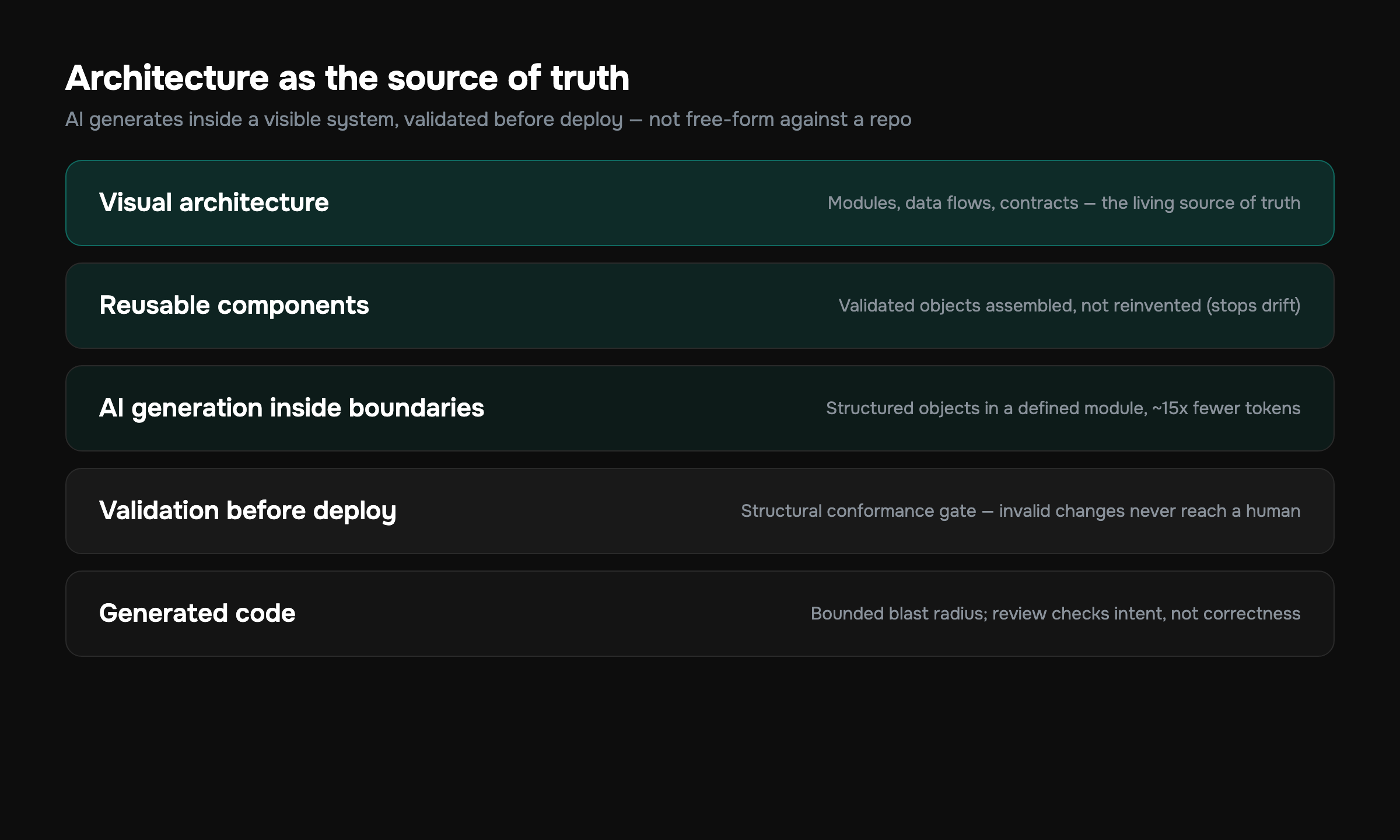
Here's the shift that resolves the trade-off. Most teams treat the repository as the primary artifact and the architecture as documentation that rots. Invert that. The architecture becomes the living, executable source of truth, and the code is generated downstream of it.
In practice you, the CTO or your architects, define the system as a visual model first: the modules, the data flows, the APIs, the business logic, the contracts between components. The AI doesn't get a blank repository and a chat box. It gets a structured target — "implement this object, inside this module, satisfying this contract" — and it generates a structured, editable object that lives inside that architecture, not a loose blob of text appended to a file.
This is the core idea behind building software with AI you can actually see, and it's the foundation of how GitMir works. You model the product, you build the visual architecture, and AI generates structured objects inside it — validated before deploy, with reusable components, using up to ~15x fewer LLM tokens than ad-hoc prompting because the model never re-derives the system on every turn. The architecture is the prompt. The constraint is the feature.
What changes when architecture leads
| Dimension | Ad-hoc AI coding (chat against a repo) | Architecture-first AI development |
|---|---|---|
| What the AI sees | A pile of files and a text prompt | A modeled system with explicit contracts |
| Unit of generation | Free-form code into a file | A structured object inside a defined module |
| Validation | After you run it and it breaks | Against the model, before deploy |
| Blast radius | Discovered in production | Bounded by the architecture up front |
| Consistency | Drifts with every prompt | Enforced by reusable components |
| Token cost | Re-sends whole-file context every turn | Pays for stable context once (~15x cheaper) |
| Reviewer's job | Read every diff and pray | Confirm the change fits a known boundary |
The right-hand column isn't slower. It's faster and safer, because the expensive parts — comprehension, review, and rework — get cheaper exactly where ad-hoc workflows make them more expensive.
Validation before deploy: where control gets enforced
The single highest-leverage control a CTO can install is a validation gate that runs before human review and before deploy. Not the test suite running after the fact, but a structural check that the generated change conforms to the architecture it was supposed to fit.
This is the difference between "we'll catch it in code review" and "it can't violate the contract in the first place." When AI output is validated against a real model of your system — types, interfaces, data flows, module boundaries — before anyone looks at it, two things happen:
- The repair loop collapses. Most invalid generations never reach a human, so you stop paying the round-trip cost of discovering breakage by running it. (That's the direct link between validating AI-generated code and your token bill — fewer invalid generations means fewer expensive re-prompts.)
- Review stops being a correctness check and becomes a judgment check. Your senior engineers stop asking "does this even work and fit?" and start asking "is this the right thing to build?" — which is the only review question worth a senior's time.
Code review at AI speed is impossible. Architecture review at AI speed is trivial — because you're reviewing whether a change fits a boundary you already drew, not re-deriving the whole system from a diff.
That reframing is how you escape the review-collapse trap from earlier. You don't make humans review faster. You make most of what they were reviewing unnecessary, by catching structural violations mechanically and reserving human attention for intent.
Where the AI coding tools fit (and where they stop)
Let's be fair to the landscape, because a CTO making a platform decision needs an honest map, not a sales pitch. Each category solves a real problem, and each has a ceiling you'll hit.
- Cursor and GitHub Copilot are excellent in-editor assistants. They make a competent engineer faster line-by-line and are superb for autocomplete, refactors, and exploration. Their ceiling: they operate on files, not on a system model. They make generation faster without making containment better, which is exactly the lever DORA's data says matters.
- v0 and Lovable are strong at spinning up UI and front-end scaffolding from a prompt. The ceiling: gorgeous starting points that drift the moment real business logic, multi-module data flows, and long-lived maintenance enter the picture.
- Replit Agent is impressive for end-to-end app generation and prototyping in a hosted environment. The ceiling: it optimizes the zero-to-running path, not the "now keep fifteen engineers coherent on this for two years" path.
- Bubble and classic no-code give you visual building and real guardrails, which is genuinely closer to the architecture-first spirit — but at the cost of being a closed platform you don't own the code of, with the scaling and lock-in trade-offs that implies.
The pattern is the same across the board. Most of the market optimizes generation speed. The gap a CTO should care about is generation inside a system that can't be silently violated. That's the slot GitMir is built for — visual architecture plus AI generation inside it plus validation before deploy — and you can see the head-to-head reasoning on the comparison page. Use the editor assistants for what they're great at. Just don't mistake a faster generator for a system that stays coherent.
A realistic scenario: the same feature, two ways
Make it concrete. A B2B SaaS team needs to add usage-based billing to an existing product. Mid-size feature, real integration surface, a 60k-LOC codebase.
The ad-hoc path. An engineer opens an AI chat, attaches a handful of files, and asks for a metering service. The model produces something reasonable. It also invents a third Account representation because it never saw the two that already exist, wires directly into the user table (invisible coupling), and the change quietly touches the export module because the model guessed at a shared helper. Tests pass — they don't cover the export path. It ships in a big batch. Three weeks later finance reports drift, and a senior spends two days tracing a dependency that was never supposed to exist. Fast to write, expensive to own. This is the exact failure mode behind the hidden cost of vibe coding.
The architecture-first path. The same feature starts as a model: a Metering module with explicit contracts to the existing Billing and Account components, a defined data flow, and a reusable UsageEvent object. The AI generates the implementation inside those boundaries. It can't invent a third account shape — the contract points at the real one. The change can't reach the export module, because that boundary isn't in scope. Validation against the model catches a type mismatch before a human ever sees it. The reviewer confirms the design is right in ten minutes, not whether it works at all. Same speed to first draft. A fraction of the cost to live with.
The difference isn't talent or model quality. It's whether the AI was generating into a structure or into a void.
How a CTO actually rolls this out
You don't fix this with a memo telling people to "be careful with AI." Control is a property of the system, not a property of good intentions. Here's the practical sequence:
- Model before you generate. For any non-trivial feature, the architecture — modules, contracts, data flows — gets defined first. The AI generates against that target, not into a blank file. This is the whole ballgame.
- Make validation a gate, not a hope. Structural conformance to the architecture is checked mechanically before human review and before deploy. If it can't pass the model, it doesn't reach a person.
- Standardize reusable components. Drift comes from regenerating the same concept differently. A library of validated, reusable objects means the model assembles from known-good parts instead of reinventing them — which also slashes token cost.
- Keep batches small on purpose. DORA's finding is a direct instruction: smaller, bounded changes are more stable. Architecture-first work naturally produces smaller, scoped generations. Lean into it.
- Re-point review at intent. Once correctness and conformance are mechanical, your seniors review judgment and design. That's where their leverage is, and it's the only kind of review that survives AI speed.
- Measure the right things. Track change failure rate, time-to-restore, and how often a change exceeds its expected blast radius — not lines of code shipped. Velocity that destabilizes delivery is not velocity.
There's a useful side effect here. Onboarding gets dramatically faster, because a new engineer reads the architecture instead of reverse-engineering it from a million-line repo. We dug into that in onboarding engineers faster — when the system is visible, ramp time stops scaling with codebase size.
The economics: control is also the cheaper path
CTOs get budget questions, so name the money. The architecture-first model isn't just safer; it's cheaper on two axes that compound.
Token cost. Ad-hoc AI workflows re-send your architecture to the model on every single turn, because the model is stateless and the repo is its only memory. That's where the bill goes — input tokens, re-sent four times per feature. When the architecture is the durable source of truth and components are reusable, the model stops re-deriving the system, and the same feature can cost roughly 15x fewer tokens than the brute-force approach. Run your own numbers on the ROI calculator — the savings are mechanical, not aspirational.
Human cost. The expensive line items in AI development aren't generation. They're rework, debugging invisible coupling, and senior time spent reconstructing a system that should have been legible from the start. Every structural violation caught before deploy is a repair loop you don't pay for, in tokens and in engineer-hours. Control and cost-efficiency turn out to be the same investment viewed from two angles.
The cheapest line of AI-generated code is the one that was correct, in-bounds, and validated before a human ever read it. The most expensive is the one that looked fine, shipped, and quietly entangled two modules you'll untangle for a week.
The CTO's actual job in the AI era
Step back. The role is changing, and pretending it isn't is how you get blindsided. For twenty years, a CTO's leverage came largely from hiring and directing people who write code. AI is collapsing the cost of writing code toward zero. The leverage is moving — fast — from who writes the code to who defines the system the code is written into.
That's not a downgrade of the role. It's a promotion. Your most valuable artifact is no longer the repository; it's the architecture that governs what the repository is allowed to become. The engineering leaders who win the next few years won't be the ones whose teams generate the most code. They'll be the ones who built a system where AI can move at full speed because it can't break the structure. Speed without losing control isn't a slogan. It's an operating model, and it's available now.
The teams still treating AI as a faster typewriter will keep oscillating between two failure states: rubber-stamp review that loses control, or bottleneck review that loses speed. The teams that move the AI inside a visible, validated architecture stop having to choose.
Next step
If you're carrying both the velocity pressure and the stability risk — which is every CTO right now — the move is to see the model in motion rather than take it on faith. Put your own numbers into the ROI calculator to see what architecture-first AI development does to your token spend and rework cost, walk through how visual architecture plus validation-before-deploy works on the product page, and when you're scoping it for a team, try it free. Then decide whether speed and control are still a trade-off you have to make.
More on this, with the numbers behind it
What business logic is, and where it lives →Features, rules, customer paths and how they connect — why nothing a team already owns holds them in one place, and what that costs.A week of engineering work, measured →The same workflows timed with the business logic established and without it — hours, not adjectives.GitMir Intelligence →Ask what a change reaches, what a rule holds and which customer path meets it — with the part of the product each answer came from.What your AI actually costs →Your engineers, your loaded cost, your monthly AI bill — counted on your own numbers, not ours.Ask a published model your own question →A real product, read in full. Ask it what a change reaches and check the answer against the source it came from.Put a number on your own workflow
Bring us the recurring workflow where AI still needs expensive people to supervise, review and correct. We baseline what it costs and put the target in writing before we build. Or connect a repository and see it on your own code first — 10,000 credits free, no card.
Build My Business Case → Start free →Frequently asked questions
How can a CTO use AI development without losing control of the codebase?
Keep control by moving the AI inside a defined architecture instead of letting it write free-form code against a repository. Model the system — modules, data flows, contracts — first, then have AI generate structured objects within those boundaries and validate every change against the model before deploy. Architecture becomes the source of truth; AI becomes a constrained executor.
Does AI-assisted development actually hurt software delivery stability?
It can, if speed goes unbounded. The 2024 DORA State of DevOps report found that as AI adoption rose, delivery stability dropped an estimated 7.2% — driven mainly by larger batch sizes, not bad code. AI makes it easy to ship bigger, riskier changesets. Architecture-first workflows and small, validated batches reverse that effect.
What is architecture-first AI development?
Architecture-first AI development means defining the system's structure — modules, APIs, data flows, and contracts — as the source of truth, then having AI generate code inside that model rather than into a blank repository. Output is validated against the architecture before deploy, so changes stay bounded, consistent, and reviewable at AI speed instead of drifting into incoherence.
How is GitMir different from Cursor, Copilot, or Replit Agent for a CTO?
Cursor, Copilot, and Replit Agent optimize how fast AI generates code; they operate on files, not a system model. GitMir optimizes containment: you build visual architecture, AI generates structured objects inside it, and changes are validated before deploy. That makes generation safe to run at full speed and uses roughly 15x fewer tokens than ad-hoc prompting.
How do you review AI-generated code when it's produced faster than humans can read it?
Stop reviewing for correctness and review for intent. When generated changes are validated against your architecture mechanically — before a human looks — structural violations never reach review. Engineers then confirm whether a change is the right thing to build, not whether it works or fits. That keeps review meaningful without becoming the bottleneck.
What metrics should a CTO track to keep AI development under control?
Track change failure rate, time-to-restore, batch size, and how often a change exceeds its expected blast radius — not lines of code shipped. DORA's research shows smaller batches drive stability, so watch changeset size closely. Velocity that raises your change failure rate or destabilizes delivery isn't real velocity; it's deferred risk.

Related articles
How to Migrate Legacy Software with AI (Without a Blind Rewrite)
Most legacy migrations fail because nobody fully understands the system being moved. The fix isn't translating code — it's capturing the product as a structured model first, so AI can re-platform and refactor it with real context.
The Laptop Did Not Just Change. The AI Development Model Changed
NVIDIA's Spark and the AI PC signal a shift: AI agents are moving onto the machine — always-on, local, next to your code. Why that makes architectural visibility non-negotiable.
What Is Vibe Coding? (And How to Do It Without Breaking Production)
Vibe coding means building software by prompting AI instead of writing code by hand. It's fast — but without structure it ships bugs, lost context and hidden architecture. Here's how to keep the speed and the control.