
How to Migrate Legacy Software with AI (Without a Blind Rewrite)
Most legacy migrations fail because nobody fully understands the system being moved. The fix isn't translating code — it's capturing the product as a structured model first, so AI can re-platform and refactor it with real context.
Legacy software migration fails for one reason more than any other: nobody fully understands the system being moved. The code runs, it makes money, and yet the complete picture of what it does — every entity, rule, data flow and edge case — exists nowhere except in the running binary and a few people's heads. So teams rewrite from assumptions, miss behavior that mattered, and ship a "modern" replacement that's subtly broken in ways the old system never was.
The short answer to doing this well: don't start by rewriting code. Start by reconstructing the product as a structured model. GitMir builds a structured model of your product — entities, relationships, business logic, data flows, APIs, UI, roles, permissions, states, events, dependencies and more — and that model carries enough context for AI to regenerate the system on new technologies and refactor it safely, instead of guessing its way through a blind rewrite.
This article is about that approach: why legacy migration is really a comprehension problem, what it means to capture a codebase as a model rather than a pile of files, and how an architecture-first migration avoids the failure mode that sinks most modernization projects.
Why legacy migration is so hard
A legacy system isn't hard to move because the language is old. It's hard because the system is its accumulated behavior — fifteen years of bug fixes, business rules, special cases for one important customer, and undocumented assumptions that someone encoded on a Tuesday in 2014 and never wrote down. The code is the only complete specification that exists, and it's written in a form optimized for a machine to execute, not for a human to understand.
That creates a specific trap. When you decide to migrate — to a new framework, a new language, a cloud platform, a different architecture — you have to answer questions the codebase answers only implicitly:
- Which entities are real, and how do they actually relate?
- Where does each piece of data come from, and what's allowed to change it?
- Which business rules are load-bearing, and which are dead code nobody removed?
- What breaks if this field changes type, or this service moves?
- What does this button really trigger, three call-stacks deep?
Rewriting without answering these is how you get a migration that compiles, demos fine, and then quietly drops the one validation rule that kept fraudulent orders out. The research backs up how often this goes wrong: industry analysis consistently finds that a large share of software modernization and large IT projects overrun their budgets or fail to deliver the expected value, and unclear scope plus poor understanding of the existing system are repeatedly named among the leading causes. According to McKinsey's research on large IT projects, big software efforts run substantially over budget on average and a meaningful fraction deliver far less value than predicted — and the projects that fail most often are the ones where the team never built a shared, accurate picture of what they were actually changing.
The real problem is comprehension, not translation
Most people frame migration as translation: take the Java, produce the Go; take the monolith, produce the services. Framed that way, an AI looks like a perfect fit — large language models are genuinely good at converting code from one form to another.
But line-by-line translation is exactly the wrong altitude. It faithfully reproduces the old system's structure, including its mistakes, while losing the one thing you actually wanted to preserve: the intent. You don't want a Go copy of a tangled Java service. You want the behavior that service guaranteed, re-expressed cleanly on the new stack. Those are different goals, and only one of them is worth the cost of a migration.
This is where AI alone, pointed at raw files, runs into a wall. An agent that re-reads your code one prompt at a time has no durable, system-wide picture. It sees the file in front of it, not the web of dependencies around it. It can translate a function, but it can't know that this function is the only place a particular invariant is enforced, because that fact lives in the relationship between files, not in any one of them. The missing ingredient isn't a better model. It's a representation of the whole product that the model can reason against.
What a structured product model captures
The alternative to translating files is to first reconstruct the product as a model — a structured, machine-readable description of what the system is, independent of the language it currently happens to be written in. GitMir captures it across the whole product. A representative slice:
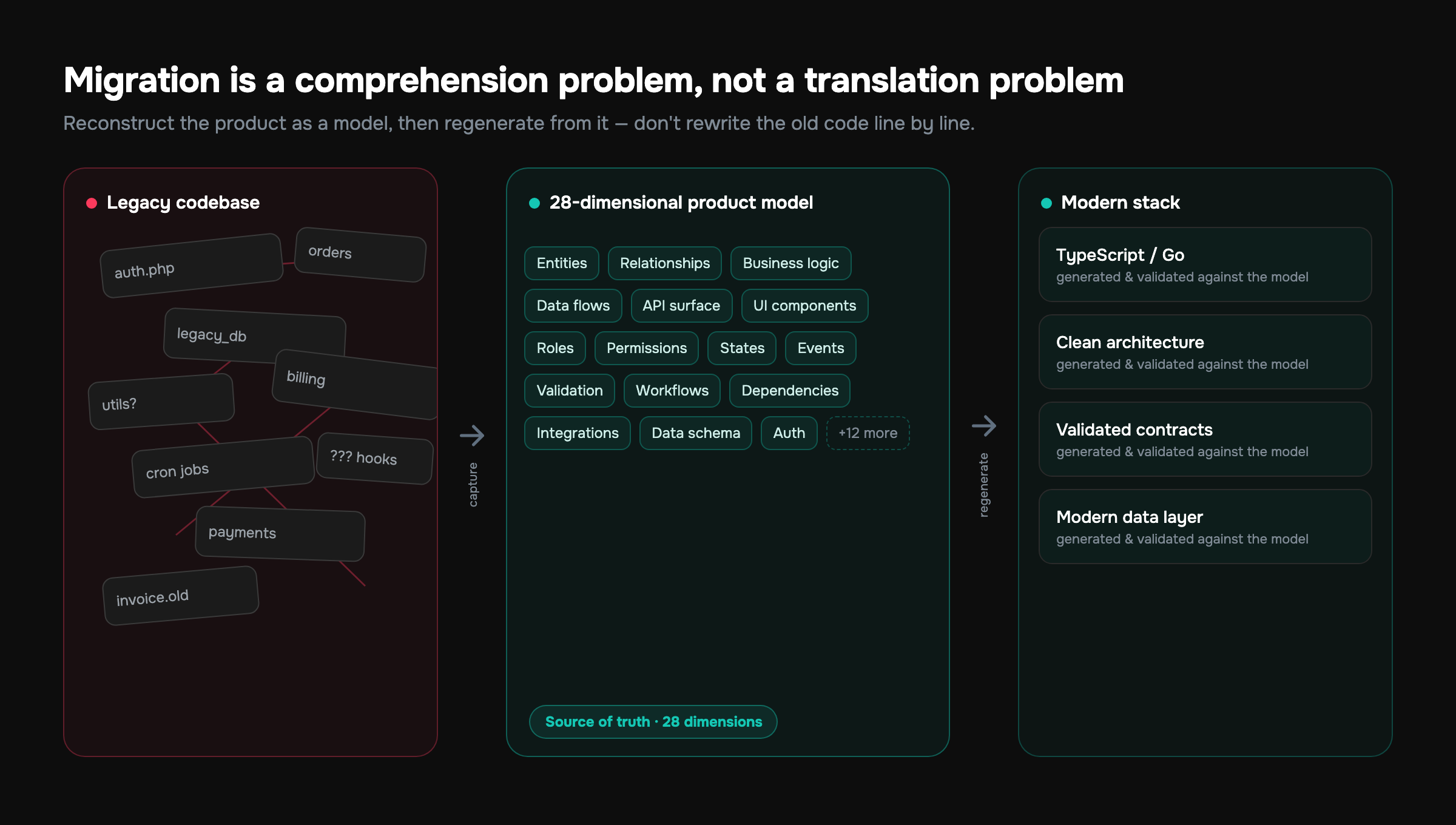
- Entities and relationships — the real nouns of the system and how they connect, recovered from the data and the code that touches it.
- Business logic and rules — the validations, calculations and conditions that define correct behavior, made explicit instead of buried.
- Data flows — where each value originates, what transforms it, and which component is allowed to write it.
- API surface and contracts — the inputs, outputs and shapes other systems depend on.
- UI components, screens and states — the front end as structure, not just markup.
- Roles, permissions and auth — who can do what, and where that's enforced.
- Events, side effects and background jobs — the asynchronous behavior that line-by-line reading usually misses.
- Dependencies and integrations — the external edges that constrain any rewrite.
The point of capturing this many dimensions isn't completeness for its own sake. It's sufficiency of context. Once the product is represented this richly, an AI generating the new implementation isn't guessing — it's working against an explicit specification of what has to remain true. The model becomes the source of truth, and the new code is generated and validated against it.
How architecture-first migration works in practice
The workflow inverts the usual order. Instead of read code → rewrite code → hope behavior survived, it becomes reconstruct model → regenerate on the new stack → validate against the model.
- Capture the system as a model. Recover entities, flows, rules and dependencies from the existing codebase into the structured product model. This is the comprehension step everyone skips, and it's the one that determines whether the migration succeeds.
- Decide what to keep, fix and drop. With the product visible as structure, dead code, redundant rules and accidental complexity become obvious. A migration is the rare chance to not carry your mistakes forward — but only if you can see them.
- Regenerate on the target stack. AI generates the new implementation against the model's definitions. Because it's building from an explicit specification of entities, contracts and rules, the output is connected to the same source of truth rather than improvised from a single file.
- Validate every piece against the model. Each generated component is checked against the structure it's supposed to honor. A change that contradicts a pinned rule or breaks a contract gets caught before it ships — not discovered in production months later.
The same machinery that makes this work for a full re-platforming also makes ordinary refactoring safer. Refactoring is migration in miniature: you're changing the structure while promising the behavior stays the same. When the behavior is pinned in a model and every change is validated against it, you can restructure modules and reshape data flows with the safety net the old "change it and run the tests you happen to have" approach never gave you.
Where this leaves your team
A migration driven by a model instead of by assumptions changes the risk profile of the whole project. The comprehension work happens up front, explicitly, where you can review it — not implicitly, scattered across a rewrite where mistakes only surface later. The new system is generated against a specification you can see, so the question "did we preserve the behavior that mattered?" has an answer you can check rather than hope for.
It doesn't make migration trivial. Nothing does. The why behind some decisions — the business context, the reason a strange rule exists — still needs a human who knows the domain. But the structural reconstruction that consumes most of the effort and carries most of the risk is exactly the part a rich product model is built to handle. Legacy code stops being an opaque liability you're afraid to touch and becomes a system you can finally see, move and improve.
More on this, with the numbers behind it
What business logic is, and where it lives →Features, rules, customer paths and how they connect — why nothing a team already owns holds them in one place, and what that costs.An architecture nobody wrote by hand →Areas, customer paths, rules and status flows of a real product, built from its source and published in full.Spec-driven development with AI agents →Specs an agent can build from — and a check that the spec still matches the product.Business rules, extracted from code →Where the rules of a product actually live, and how to get them out of the code and keep them current.GitMir Intelligence →Ask what a change reaches, what a rule holds and which customer path meets it — with the part of the product each answer came from.Put a number on your own workflow
Bring us the recurring workflow where AI still needs expensive people to supervise, review and correct. We baseline what it costs and put the target in writing before we build. Or connect a repository and see it on your own code first — 10,000 credits free, no card.
Build My Business Case → Start free →Frequently asked questions
Can AI migrate a legacy codebase on its own?
Not reliably from raw files alone. An AI pointed at code one prompt at a time can translate individual functions, but it has no durable picture of the whole system, so it misses behavior that lives in the relationships between files. It works far better when it generates against a structured model of the product — entities, rules, data flows and contracts — instead of guessing from isolated snippets.
What is a structured product model?
It's a structured, machine-readable description of what a product actually is — captured across what the product holds: entities, relationships, business logic, data flows, APIs, UI components, roles, permissions, states, events, dependencies and integrations. GitMir builds this model so there's enough context to regenerate the system on new technologies and refactor it without losing behavior that matters.
Why do so many legacy migrations fail?
Because they're treated as code translation when they're really a comprehension problem. Teams rewrite from assumptions instead of from an accurate model of the existing system, so subtle business rules and edge cases get dropped. Research on large IT projects repeatedly ties overruns and failures to unclear scope and poor understanding of the system being changed.
Is migrating to a model-first approach the same as refactoring?
They're the same idea at different scales. Refactoring changes a system's structure while promising its behavior stays the same; migration does that across a whole stack or platform. In both cases, pinning the behavior in a model and validating every change against it is what lets you restructure safely instead of hoping the tests you happen to have catch the regressions.
Does model-first migration mean rewriting everything at once?
No. Capturing the product as a model actually makes incremental migration safer, because you can see exactly which entities, flows and dependencies a given piece touches before you move it. You can re-platform one bounded area at a time, validate it against the shared model, and keep the rest of the system running — rather than betting the business on a single big-bang rewrite.
What still needs a human in a legacy migration?
The rationale. A model can recover what the system does and how its parts connect, but the business reasons behind certain rules — why a boundary sits where it does, which odd special case is load-bearing — need someone who knows the domain. That judgment is the irreducible part you author; the structural reconstruction is what the product model handles for you.

Related articles
The Laptop Did Not Just Change. The AI Development Model Changed
NVIDIA's Spark and the AI PC signal a shift: AI agents are moving onto the machine — always-on, local, next to your code. Why that makes architectural visibility non-negotiable.
What Is Vibe Coding? (And How to Do It Without Breaking Production)
Vibe coding means building software by prompting AI instead of writing code by hand. It's fast — but without structure it ships bugs, lost context and hidden architecture. Here's how to keep the speed and the control.
What Is AI-Native Development? A Plain-English Guide
AI-native development means building software where AI is the primary builder and humans direct, review and architect. Here's what changes, what stays, and how to do it without losing control.