
v0 vs GitMir: From UI Generation to Full Systems
v0 is brilliant for generating UI from prompts. GitMir builds the whole system — architecture, logic, data — visually and under control. Here's how they compare.
If your job today is "make a beautiful React component that looks production-grade in thirty seconds," v0 is one of the best tools that has ever existed for it. Describe a pricing table, a dashboard card, a settings page. It hands you clean, idiomatic, Tailwind-styled JSX you can paste straight into your app. As a generative UI engine it is genuinely excellent, and pretending otherwise would waste your time. So this v0 vs GitMir comparison starts by giving v0 its due.
"Generate a UI" and "build a system" are different problems, though, and the distance between them is where most AI-assisted projects quietly stall. v0 produces screens. A real product is screens plus data flows, business logic, integrations, permissions, and the invariants that have to hold across all of them — and someone, eventually, has to keep all of that coherent while it changes for years. v0 doesn't claim to own that layer. The mistake teams make is assuming a great UI generator will somehow grow into a great system, then acting surprised when it doesn't.
That's the line this comparison is about. v0 is a generative UI tool: prompt in, component out, and the architecture of your actual application lives somewhere else entirely — usually your head, or your repo's accumulated conventions. GitMir is an AI-native system: you model the product as visual architecture first (modules, data flows, APIs, business logic), and AI generates structured, editable objects inside that architecture, validated before deploy. Same AI horsepower pointed at a different problem. Below is the honest version of where v0 wins, where it was never meant to compete, and how to tell which one your project actually needs.
v0 vs GitMir at a glance
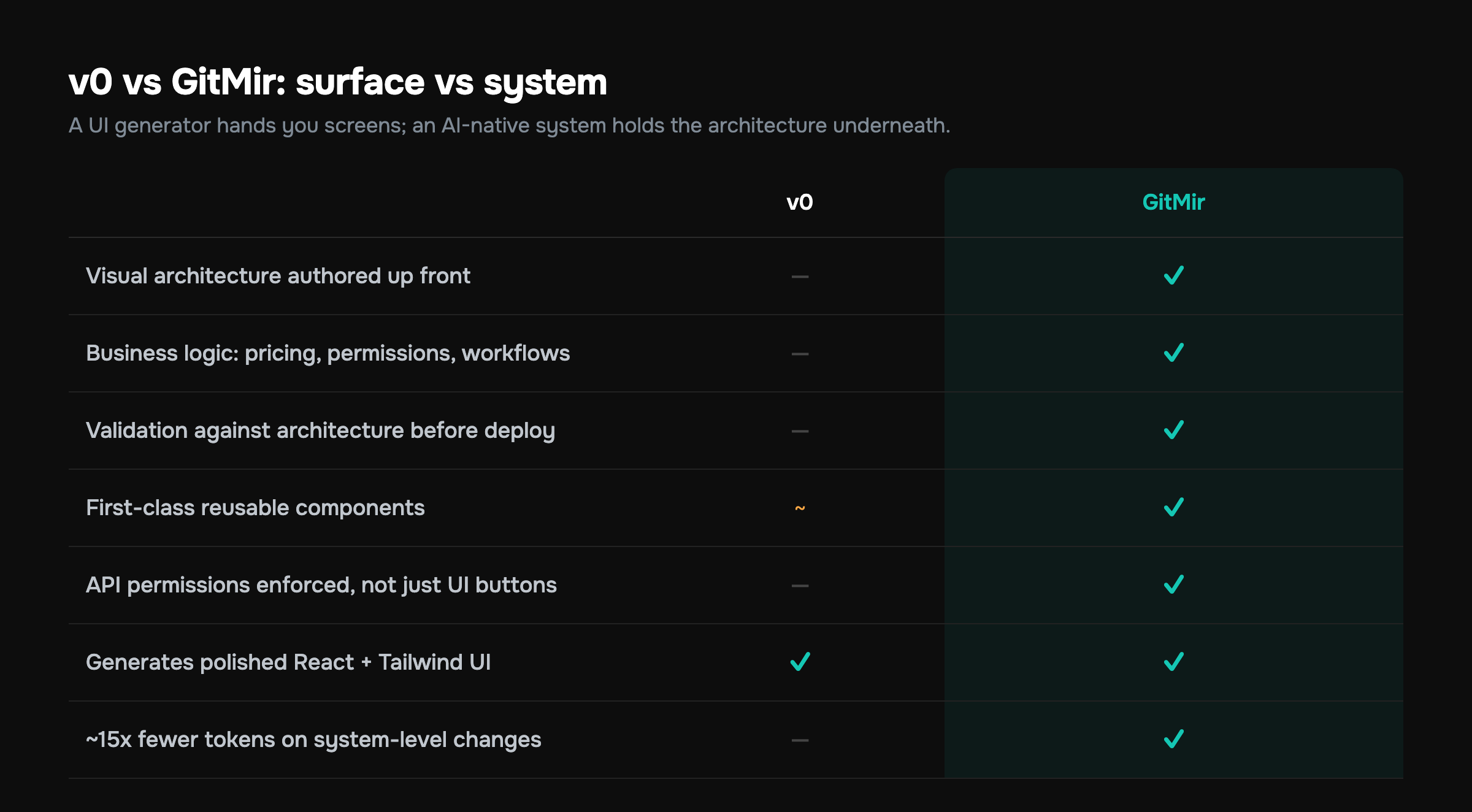
Before the nuance, the one-screen version. These tools get mentioned in the same breath, but they answer different questions about your build.
| Dimension | v0 (generative UI) | GitMir (AI-native system) |
|---|---|---|
| What it generates | UI components, screens, front-end surface | Structured objects inside a modeled architecture |
| Where architecture lives | Outside the tool (your repo / your head) | Explicit, visual, authored up front |
| Scope of a change | A component or page | A bounded module wired to data flows and APIs |
| Business logic | Not its job | First-class: pricing, permissions, workflows |
| Pre-deploy safety | Visual preview | Validation against the architecture |
| Reuse | Copy/paste or re-prompt | First-class reusable components |
| Token cost per change | Low per component, but you own integration | ~15x fewer for equivalent system-level work |
| Best fit | Front-end velocity, design exploration | Software you'll maintain and grow |
The short read: v0 is the fastest way to the look of a product. GitMir is a way to build the system underneath it that survives contact with real users. If you only ever needed the look, you wouldn't be comparing them.
What v0 is genuinely great at
Let's be specific and fair, because dismissing v0 would be both wrong and useless to you. Some jobs are exactly its wheelhouse, and reaching for a full system on those would be overkill.
v0 shines when:
- You need front-end surface area, fast. Marketing sections, dashboard layouts, form-heavy settings pages — v0's prompt-to-component loop is hard to beat for raw UI velocity.
- You're exploring design directions. Generating five variations of a hero section to react to beats hand-coding one. It's a thinking tool as much as a building tool.
- You already have a system and just need the skin. If your backend, data model, and business logic exist and are sound, v0 dropping in polished components is pure upside.
- The output is React + Tailwind and that's your stack. v0 leans into the modern React ecosystem, so the generated code feels native rather than foreign.
v0's superpower is turning a description into a component that looks like a senior front-end engineer built it. That is a real and valuable thing. It just isn't the same thing as building an application.
That zone is large and legitimate. Trouble starts when the zone gets stretched — when "generate the UI" silently becomes "build the product," and the parts v0 was never responsible for become the parts that decide whether the thing ships and holds up.
Where UI generation stops being enough
Picture the realistic arc. You generate a gorgeous front end for a B2B scheduling tool with v0 in an afternoon, and stakeholders love the demo. Then the real work arrives. Bookings have to respect availability windows. Double-booking must be impossible. Cancellations trigger refunds within a policy window. Admins see everything, members see only their own data, and a calendar integration has to stay in sync.
None of that is UI. All of it is the system. And here's the structural problem: v0 generated screens that assume this logic exists, but nothing about those screens encodes or enforces it. You — or another AI session, or another engineer — now have to:
- Wire the components to a data model that v0 never modeled.
- Implement the booking invariants somewhere, consistently, by hand or by prompting a different tool.
- Make sure the permission rules the UI implies are actually enforced on the API, not just hidden in the front end.
- Keep all of it coherent the next time someone regenerates a component and the props shift.
This is the integration gap. The components are real, but they're islands. The connective tissue — the architecture — is exactly the part a UI generator leaves to you, and it's the part that's hard, slow, and unforgiving.
A generated UI is a promise about behavior. Something else has to keep that promise. With a pure UI tool, that "something else" is unglued effort scattered across your repo and your memory.
The three places the gap bites
- Logic with no home. Business rules get sprinkled across components, hooks, and ad-hoc backend code, because there's no single modeled place they belong. Six months later nobody can say where "the refund policy" lives.
- Permissions that exist only in the UI. The most common AI-built security hole: a button hidden in the front end while the underlying endpoint stays wide open. UI generation makes the button trivial and the enforcement invisible.
- Regeneration churn. Re-prompt a component for a tweak and its prop shape changes. Now the integration code you wrote around it breaks, quietly, because nothing connected the two.
How GitMir closes the gap: architecture first
GitMir's answer isn't "less AI" or "no generated UI." It's AI inside a controlled system, where the architecture is something you author on purpose rather than an emergent side effect of whatever components got generated.
1. Visual architecture before generation
You model the product visually first: modules, data flows, APIs, business logic. The scheduling tool's "booking" isn't a screen that implies rules — it's a defined object in a defined module, with explicit inputs, outputs, and relationships to availability, refunds, and permissions. The architecture is the contract, and you can review it in minutes because it's a diagram, not 4,000 lines of regenerated code.
2. AI generates structured objects inside that architecture
Ask for a feature and the AI doesn't free-write across your codebase or hand you an unattached component. It produces structured, editable objects that slot into the model you authored — scoped to the right module, wired to the right data flows. The blast radius of any change is bounded by design, not by hope.
3. Validation before deploy
Because the system knows the architecture, it can validate against it. Does the new booking object respect the availability invariant? Is every protected route actually wired to the permission module? Is the refund path consistent with the policy? Those become validation failures caught before deploy, not production incidents discovered by a user. This is the step a UI generator structurally cannot offer, because it has no model to validate against.
4. Reusable components
A pattern you define — an auth flow, a billing module, a notification pipeline — becomes a reusable component, not something re-derived (slightly differently) every time. And GitMir still produces the UI. The difference is that the UI is generated as part of a system that knows what it's connected to, instead of as a beautiful island you have to bridge by hand.
v0 gives you components and leaves you the architecture. GitMir gives you the architecture and generates the components inside it. The order is the whole difference.
The same feature, two philosophies
Concrete beats abstract. Say you're adding role-based access control — admins, managers, members — to your scheduling app.
With a UI generator (v0-style)
- Prompt v0 for an admin panel, a members table, and role-aware navigation. You get clean, good-looking components.
- The components conditionally render based on a
roleprop. The demo looks correct: admins see the admin panel, members don't. - You wire it up. Somewhere, you write the actual permission checks — on some routes, by hand, in whatever pattern you remembered that day.
- Two weeks later you discover a manager can call an admin-only API directly. The UI hid the button; the endpoint never checked the role. The generated component did exactly its job. The system-level invariant was never anyone's job.
The failure stays invisible until production because nothing enforced "every protected route checks the role." v0 was never asked to — that's outside UI.
With an AI-native system (GitMir)
- You define roles and permissions as part of the architecture: a module with explicit rules wired into your data flows and APIs.
- AI generates the role objects, the checks, and the UI inside that model.
- Validation runs against the architecture before deploy: every route wired to the protected module is checked for the rule. A gap is a validation failure, not an incident.
- The RBAC module becomes a reusable component for the next product you build.
Same AI, same request. What changes is whether "all protected routes enforce the rule" is a hope you maintain by hand or an invariant the system checks for you. We go deeper on this exact failure pattern in build software with AI you can see.
What the research says about the gap between speed and correctness
Worth grounding this in evidence rather than vibes, because the speed of AI generation is real and easy to overweight. According to McKinsey's research on generative AI and developer productivity, developers using AI assistance completed many common coding tasks substantially faster — a genuinely large productivity gain that maps cleanly onto how fast v0 produces UI. The lift is not in doubt.
The catch: velocity at the keystroke level is not velocity at the system level. The industry-wide DORA State of DevOps research has consistently found that what actually predicts software delivery performance is not raw output but stability and the ability to change systems safely — fast lead time and low change-failure rate, together. A tool that makes generating a screen 55% faster does nothing for change-failure rate if the screen isn't bound to an enforced architecture. That's the precise gap GitMir is built to close: keep the generation speed, add the structural safety that turns speed into shipped, durable software.
Faster generation is a real win. But the metric that decides whether a product survives is whether changes are safe — and safety comes from enforced structure, not from how quickly the UI appears.
The token economics nobody puts on the pricing page
Here's the part founders underestimate, and it's the most quantifiable system-level advantage. Every AI build tool spends LLM tokens, and tokens are the real unit cost of AI development. The question is how efficiently — and the answer is downstream of whether there's an enforced architecture.
A UI generator is cheap per component because the scope is small: one screen, regenerated. But it pushes the expensive part — integrating that screen into a coherent system — back onto you, and onto whatever AI tool you use for the rest. When the broader system has no enforced model, making a change there is expensive in tokens for a structural reason:
- It often has to load large swaths of the codebase into context to "understand" the app again.
- It re-infers relationships that were never written down as a model.
- It regenerates more than the change strictly requires, because it can't safely target a small surface.
GitMir's architecture-first approach flips this for system-level work. Because the platform already holds the model of your app, the AI operates on a scoped, structured context — it changes the object that needs changing, not the surrounding 2,000 lines it had to re-read to feel safe. In practice that's up to ~15x fewer tokens for equivalent work.
Fewer tokens isn't just a cheaper invoice. It's a proxy for how much the AI has to guess. Less guessing means less drift, fewer regressions, and changes you can actually trust.
Want to see what that compounding difference does to a real budget and timeline? The ROI calculator lets you plug in your own numbers instead of trusting a blog post's hand-waving. Token efficiency is one of the clearest dividing lines across the whole AI build-tool comparison.
How to choose: a decision framework
Don't pick by hype, and don't pick as if these tools compete head-to-head — mostly they don't. Pick by the shape and lifespan of what you're building.
Reach for v0 when:
- You need front-end surface area or design exploration, fast.
- You already have a sound system and just need polished components dropped in.
- The output is throwaway UI for a demo, pitch, or A/B test.
- Your stack is React + Tailwind and you want native-feeling JSX.
Reach for an AI-native system like GitMir when:
- Real people will depend on it and you'll maintain it for years.
- There's meaningful business logic: pricing, permissions, workflows, integrations.
- More than one person — or one AI session — will touch the codebase.
- "It looks right in the preview" is not a high enough bar to ship.
The honest middle path
Plenty of teams use both, and that's legitimate. Explore the UI fast with v0, then build the durable system on an architecture-first foundation. The mistake isn't using v0. The mistake is letting a pile of beautiful generated components become your production system by accretion, with the architecture forever deferred to "when there's time."
The cheapest moment to introduce architecture is before you've wired fifty unattached components together by hand. The most expensive moment is the week after a permission gap reaches production.
Where each tool fits in the broader landscape
It helps to see the field rather than a two-way fight:
- v0 — best-in-class generative UI. Brilliant for front-end surface area and design exploration; not a system for full-app logic, data, and invariants. It never claimed to be.
- Cursor / GitHub Copilot — AI inside your editor. Maximum control, zero scaffolding; you bring the architecture and the discipline. Great for engineers, no help to non-coders.
- Lovable — prompt-to-app with real, editable code and sensible defaults. A strong "idea to clickable product" loop, with the same implicit-architecture risk at scale. (Full breakdown: Lovable vs GitMir.)
- Replit Agent — agentic end-to-end builds in a hosted environment. Fast and impressive; implicit architecture again once the project grows.
- Bubble — mature visual no-code with a big ecosystem, but a proprietary runtime and AI grafted on rather than native. (Full breakdown: Bubble vs GitMir.)
- GitMir — architecture-first and AI-native. You author the system visually; AI generates validated, reusable objects — including UI — inside it. Built for the part that comes after the UI looks great.
None of these is universally "best." v0 and GitMir aren't even really competing for the same moment in a build. v0 owns the surface. GitMir owns the system underneath it that has to stay correct as it grows. You can read the full positioning on the product page and see exactly which jobs each tool is built for on the comparison page.
Common mistakes when scaling past UI generation
If you've built the front end with v0 (or generated screens with Lovable or Replit Agent) and you're feeling the integration gap, avoid these traps:
- Treating the UI as the product. A clickable, gorgeous front end is roughly the easiest 30% now. The system — logic, data, permissions, invariants — is the part that determines whether you ship and stay shipped.
- Enforcing permissions only in the front end. If the button is hidden but the endpoint is open, you don't have access control — you have the appearance of it. Enforcement belongs in a modeled, validated layer.
- Letting regeneration drift your contracts. Re-prompting a component changes its props. Without an architecture that knows what's wired to what, every regeneration silently risks breaking the code around it.
- Deferring architecture to "later." Later is when the components have multiplied and the connective tissue is load-bearing and undocumented. Introduce structure before the integration debt compounds, not after.
For a tool-by-tool view of where each option lands on this spectrum, Lovable vs GitMir covers the app-builder angle and Bubble vs GitMir covers the no-code-platform trade-offs.
The bottom line
v0 is an outstanding way to turn a description into a UI that looks like a senior engineer built it. If that's the job — front-end surface, design exploration, dropping polished components onto a system that already exists — use it and move on. It's earned its place.
But if you're building software that real people will depend on, that has actual business logic, and that you'll be changing for years, the question isn't "which tool generates the nicest screen fastest?" It's "which tool keeps the whole system correct as it grows?" That's an architecture question, and a UI generator answers it by handing it back to you. GitMir answers it on purpose: visual architecture first, AI generating validated objects — UI included — inside it, reusable components, and up to ~15x fewer tokens because the model isn't guessing at structure it should never have had to infer.
The next step is small. Put your own numbers into the ROI calculator to see what the token and maintenance difference is worth on your project, then look at how the architecture-first workflow actually works on the product page. If you're early enough that your codebase is still mostly generated UI and not yet a tangle of integration debt, that's the best possible time to look — and the cheapest. The GitMir IDE is free to start.
More on this, with the numbers behind it
What business logic is, and where it lives →Features, rules, customer paths and how they connect — why nothing a team already owns holds them in one place, and what that costs.A week of engineering work, measured →The same workflows timed with the business logic established and without it — hours, not adjectives.Every tool in this market, side by side →What each one is built for, and the line between assembling context and holding it.What your AI actually costs →Your engineers, your loaded cost, your monthly AI bill — counted on your own numbers, not ours.GitMir Intelligence →Ask what a change reaches, what a rule holds and which customer path meets it — with the part of the product each answer came from.Ask a published model your own question →A real product, read in full. Ask it what a change reaches and check the answer against the source it came from.Put a number on your own workflow
Bring us the recurring workflow where AI still needs expensive people to supervise, review and correct. We baseline what it costs and put the target in writing before we build. Or connect a repository and see it on your own code first — 10,000 credits free, no card.
Build My Business Case → Start free →Frequently asked questions
Is GitMir a replacement for v0, or do they solve different problems?
They solve different problems. v0 is a generative UI tool that turns prompts into polished React components, ideal for front-end surface and design exploration. GitMir is an AI-native system where you author visual architecture first and AI generates validated objects — including UI — inside it. Many teams explore the look with v0 and build the durable system underneath with GitMir.
Can't I just build a full app with v0 by generating every screen?
Not safely past the prototype stage. v0 generates UI brilliantly, but business logic, data flows, permissions, and invariants live outside its scope — you wire those together yourself. That integration gap is where AI-built projects break, especially permissions that exist in the UI but not on the API. An AI-native system models and validates that layer instead of leaving it to you.
What does "up to ~15x fewer tokens" actually mean in practice?
Tokens are the real unit cost of AI development, scaling with how much the model must read and regenerate per change. Tools without enforced architecture reload large parts of the codebase and regenerate more than needed. Because GitMir holds an explicit model of your app, the AI works on a scoped context and changes only the relevant object — roughly 15x less for equivalent system-level work. Model your own numbers at /roi.
When is v0 clearly the right choice over a full system?
When you need front-end velocity or design exploration fast, when you already have a sound backend and just want polished components dropped in, when the output is throwaway UI for a demo or A/B test, or when you simply want native-feeling React and Tailwind. In those cases, UI generation is exactly the right tool and a full system would be overkill.
What is the "integration gap" between generated UI and a working product?
It's the connective tissue a UI generator leaves to you: the data model, business logic, API enforcement, and invariants that generated screens assume but don't encode. Components become beautiful islands you bridge by hand, and the most common casualty is security — buttons hidden in the front end while endpoints stay open. GitMir closes the gap by generating UI inside a modeled, validated architecture.
How does GitMir compare to other AI tools like Lovable, Cursor, Replit Agent, or Bubble?
v0 excels at generative UI but not full-app logic. Cursor and Copilot are editor-based and assume you bring the architecture. Lovable and Replit Agent do fast end-to-end builds with implicit-architecture risk at scale. Bubble is mature no-code with a proprietary runtime and AI added on. GitMir is the architecture-first, AI-native option for the system beneath the UI. See /compare for the full landscape.

Related articles
Cursor vs Copilot vs GitMir: Which AI Coding Tool Keeps You in Control?
Cursor and Copilot make you faster at writing code. GitMir makes your whole system visible and controllable. Here's how they compare — and when you need more than autocomplete.
Cursor Alternatives: 6 Options for Teams Who Need Control
Cursor is a great AI editor, but it's not the only — or always the right — choice. Here are six alternatives, what each is best at, and when you need more than an editor.
GitHub Copilot Alternatives: Beyond Autocomplete
Copilot is excellent autocomplete — but autocomplete has a ceiling. Here are the alternatives for teams who need multi-file edits, agents, or full architectural control.