
Bubble vs GitMir: No-Code vs Visual AI-Native
Bubble is mature visual no-code. GitMir is AI-native: visual architecture plus AI that builds inside it. Here's how they differ for serious products.
If you're comparing Bubble vs GitMir, the honest short answer is that they solve different versions of the same wish. Both let you build software without hand-writing every line. But Bubble is a no-code app builder — you assemble an application visually inside a proprietary runtime, and the platform executes it. GitMir is a visual, AI-native development platform — you model the product as visual architecture (modules, data flows, APIs, business logic), and AI generates structured, editable objects inside that architecture, validated before deploy. One replaces code with a builder. The other puts AI to work inside a system you can see and govern.
That distinction sounds academic until you're eighteen months in. With Bubble the early speed is real, and so is the wall later. You're inside someone else's runtime, your logic lives in workflows only the Bubble editor understands, and "we want to leave" is a rewrite, not an export. The AI-native approach hands the heavy lifting to AI too, but the structure stays explicit, reviewable, and yours. So the thing you build in month one is still legible to a human and an LLM in month twenty.
So this isn't a "which tool is better" piece. It's a map of where each one fits, where each one breaks, and how to pick based on what your product is actually going to become. Below: what Bubble is genuinely great at, the lock-in and ceiling that catch teams off guard, why "AI inside controlled architecture" is a different category than "no-code with AI bolted on," and an honest read on when GitMir is overkill and you should just stay in Bubble.
Bubble vs GitMir at a glance
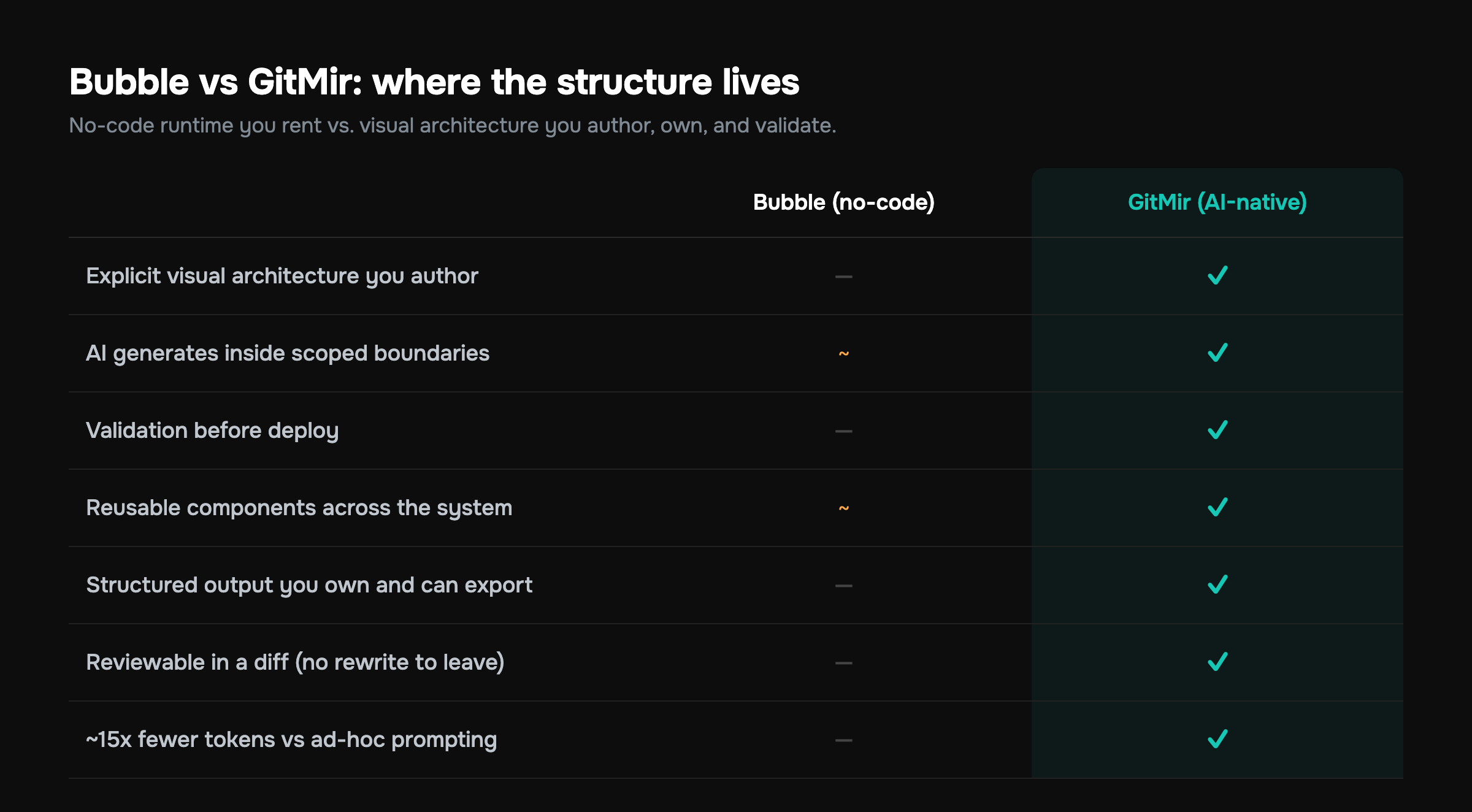
Before the nuance, here's the structural comparison most people actually want:
| Dimension | Bubble (no-code) | GitMir (visual AI-native) |
|---|---|---|
| Core unit you build | Visual elements + workflows in a proprietary editor | Visual architecture: modules, data flows, APIs, business logic |
| How logic gets created | You drag and configure it by hand | AI generates structured, editable objects inside your architecture |
| Where structure lives | Bubble's runtime and database | An explicit model you author and own |
| Output | An app that runs on Bubble's platform | Real, structured objects validated before deploy |
| Reusability | Reusable elements, limited cross-app | Reusable components across the architecture |
| Escape hatch | Hard — leaving means rebuilding | You keep the structured output |
| Best fit | Internal tools, MVPs, form-heavy CRUD apps | Products meant to grow, be reviewed, and survive a team |
Keep this table in mind. Every section below is really just an expansion of one of these rows.
What Bubble is genuinely great at
Let's be fair, because dismissing Bubble would be both wrong and useless to you. It has earned its place, and for a real class of projects it's the correct call — GitMir would be overkill.
Bubble shines when:
- You're a non-engineer who needs a real, working app. No-code's whole promise is collapsing the gap between "I have an idea" and "I have something users can log into." Bubble delivers that better than almost anything in its category.
- The app is mostly CRUD and forms. A directory, a booking tool, a lightweight marketplace, an internal admin panel — create, read, update, delete over a handful of data types, with auth and a dashboard. Bubble's defaults cover this cleanly.
- You want hosting, database, and deploy handled for you. You're not standing up infrastructure. The platform runs the thing. For a solo founder, that's enormous leverage.
- Speed-to-first-version beats everything else. If your goal this month is to validate demand with a clickable product, Bubble's visual editor and large plugin ecosystem get you there fast.
No-code's superpower is removing the engineer from the critical path for the first version. For a directory, an internal tool, or a "does anyone even want this" MVP, that's not a gimmick — it's a genuine unlock.
That's a real and valuable zone. If your product lives entirely inside it — a tool you'll use internally, a niche app that won't need a real engineering team, a prototype whose job is to be validated and maybe thrown away — you may not need anything more than Bubble. The trouble is that most products don't stay there. They get traction. And traction is exactly where the no-code bill comes due.
The core difference: a runtime you rent vs. architecture you own
Strip away the marketing and almost every build tool sits on a spectrum defined by one question: where does the structure of your software live, and who can read it?
On one end you have raw prompt-to-code tools — Cursor, GitHub Copilot, Replit Agent — where structure lives in the engineer's head and whatever conventions the repo happened to have. In the middle sit AI app builders like Lovable and v0, which generate real code but leave the architecture implicit, as the emergent sum of every prompt. Then there are no-code platforms like Bubble, where structure lives inside a proprietary builder and database. Visual, yes, but tied to a runtime you don't control and can't fully take with you.
GitMir moves the structure to the front and keeps it yours. You define the architecture as an explicit, visual model — modules, data flows, APIs, business logic — and AI generates structured, editable objects within those boundaries.
With Bubble, your architecture is whatever the platform's editor lets you express, executed by a runtime you rent. With GitMir, the architecture is a design you author on purpose, AI fills it in, and the output is structured and yours.
That difference is invisible in week one. By month six it's the entire story, because the questions change. Early on, the question is "can I build this screen?" Later it becomes "can anyone — human or AI — reason about and safely change what's already here, and could we leave if we had to?" No-code answers the first question beautifully and the second one badly.
Why "where structure lives" decides everything
- Reviewability. You can review a diagram of modules and data flows in minutes. You cannot meaningfully review three hundred interlocking Bubble workflows, and you definitely can't
git diffthem. - Portability. When structure lives in a vendor's runtime, "we've outgrown this" means "we rebuild from scratch." When structure is an explicit model that emits real output, leaving is a migration, not a resurrection.
- Predictability. Implicit or vendor-locked structure means every change risks contradicting an earlier decision nobody can see. Explicit architecture constrains new work to fit what already exists.
Where no-code breaks: the ceiling and the lock-in
No-code doesn't fail loudly. It fails on a schedule. There are two predictable walls, and almost every successful no-code product eventually hits at least one.
Wall one: the complexity ceiling
No-code platforms trade flexibility for accessibility. That's the deal, and for simple apps it's a great deal. But complexity isn't linear. The realistic scenario looks like this.
You build a marketplace MVP in Bubble. Weeks one and two are euphoric — listings, search, profiles, a checkout flow, all assembled visually. Then the requirements that make a real business show up:
- "Sellers need payouts with a 5% platform fee, held for 7 days, with refunds clawing the fee back correctly."
- "We need role-based permissions across four user types and an audit log."
- "Search has to handle 200k listings with faceted filters under 300ms."
- "Compliance wants every state transition logged and exportable."
Each of these is expressible in code in a contained, reviewable way. In a no-code workflow editor, each becomes a sprawling web of conditions, custom states, and plugin glue that only the person who built it can hold in their head. The app doesn't stop working. It becomes the thing nobody wants to touch. That's the ceiling: the point where the next feature is harder than the last five combined, because the platform's abstractions are now fighting the problem instead of helping it.
The dangerous part of a no-code ceiling isn't that something becomes impossible. It's that everything becomes expensive and fragile at exactly the moment your product is finally working.
Wall two: lock-in and the rewrite tax
This is the quieter, more serious one. Your business logic in Bubble is expressed in Bubble's primitives, stored in Bubble's database, executed by Bubble's runtime. There's no clean export to a standard codebase. So when you outgrow the platform — for performance, for compliance, for a real engineering team, for cost — "migrating off" usually means rebuilding the product from the requirements up, while the live version keeps running and accruing changes.
Founders rarely price this in. The early speed is borrowed against a future rewrite, and the interest compounds with every feature you add to a system you can't take with you. No-code isn't a trap. The exit cost is just invisible until you need the exit.
"AI inside controlled architecture" is a different category
Here's where the comparison gets interesting, because Bubble — like nearly every platform now — has added AI. And it's worth being precise about what that means, because "no-code with an AI assistant" and "AI-native" are not the same product.
When AI is bolted onto a no-code builder, the AI helps you assemble the same proprietary workflows faster. The output still lives in the runtime. The structure is still implicit and still locked in. You've sped up the part that was already the easy part, without changing the part that hurts later.
AI-native means the architecture is the primary artifact, and AI operates inside it. The order of operations is reversed:
- You model the system first. Modules, data flows, APIs, business logic — as explicit, visual architecture. This is the thing you and your team reason about.
- AI generates inside the boundaries. Instead of free-styling whatever the prompt implied, the model produces structured, editable objects that fit the architecture you defined. The blast radius of any generation is scoped, not "the whole app."
- Validation happens before deploy. Generated output is checked against the architecture before it ships, so structural mistakes get caught at design time instead of in production.
- Components are reusable. Build a pattern once — an auth module, a payout flow, a data pipeline — and reuse it across the system instead of re-deriving it everywhere.
This is the GitMir model, and it's a fundamentally different control surface than "AI that drives a no-code editor." The AI still does the heavy lifting. It just isn't allowed to invent or hide the structure.
No-code asks AI to assemble the builder for you. AI-native asks AI to fill in an architecture you authored and can review. Same horsepower, opposite control surface.
For the deeper version of this argument across other tools, the Lovable vs GitMir breakdown and the v0 vs GitMir comparison walk through where implicit-architecture builders win and where they crack.
The token economics most comparisons skip
There's a cost dimension to this that rarely makes it into a no-code vs AI-native conversation, and it's becoming a real line item.
When AI has to re-read and re-infer an entire application to make one change — because the structure is implicit, scattered, or locked in a runtime it has to reverse-engineer — you pay for that inference every single time, in tokens and in drift. When the architecture is explicit and the AI only has to reason about the relevant module and its contracts, the same change costs a fraction of the context. That's where GitMir's roughly 15x fewer tokens versus ad-hoc prompting comes from in practice: the model isn't re-deriving the world on every request, it's operating on a scoped, structured slice of it.
That's not a rounding-error saving as usage scales. If you want to put real numbers against your own situation, the ROI calculator and the deeper dive in reducing AI token costs are the honest place to do it.
What the research says about AI speed vs. stability
It's tempting to treat "AI builds it fast" as an unconditional win. The data is more nuanced, and the nuance is exactly the GitMir thesis.
According to DORA's State of DevOps research, which has studied software delivery performance across tens of thousands of practitioners for over a decade, AI adoption is associated with meaningful gains in throughput and individual productivity — but those gains do not automatically translate into more stable software delivery, and in some cohorts AI adoption correlated with reduced delivery stability. Their ongoing work on the ROI of AI-assisted development frames the same tension directly: speed without the surrounding system to absorb it can erode the very stability that makes shipping fast actually valuable.
Faster generation, whether from a no-code builder or an LLM, only compounds into a durable advantage if there's an architecture and a validation step to keep the speed from becoming chaos. Without that, you're just accumulating risk more efficiently.
This is the empirical backbone of the whole argument. The bottleneck in modern software was never typing speed. It's keeping a growing system coherent enough to change safely. No-code removes the typing. AI removes more of it. Neither, on its own, solves coherence. Explicit, validated architecture does.
When to choose Bubble, and when to choose GitMir
Honest decision rules, no hand-waving.
Choose Bubble when:
- You're a non-technical founder and the goal is a working app, this month, that you can operate yourself.
- The product is form-and-CRUD-shaped: directories, internal tools, booking systems, simple marketplaces.
- You don't expect to hire an engineering team that will need to read, review, and extend the codebase.
- Throwaway or "good enough forever at this scale" is genuinely acceptable, and you've accepted the exit cost.
Choose GitMir when:
- The product is meant to grow — real business logic, integrations, multiple data flows, branching rules.
- More than one person (human or AI) will work on it over time and will need to reason about the system, not just operate it.
- You want AI's speed without surrendering control of the structure or locking yourself into a runtime.
- "Could we review this change, validate it before deploy, and reuse this component elsewhere?" needs to be "yes."
The honest middle case: if you're a technical founder who'd otherwise reach for raw prompt-to-code tools and is worried about the architecture drifting into an unmaintainable mess, GitMir is squarely aimed at you. If you're a non-coder building an internal CRUD tool, Bubble is probably the lighter, righter call — and that's fine. For the broader landscape of what to pick at what stage, the best AI tools for startups lays out the full field.
A realistic 18-month story
Two founders, same idea — a B2B marketplace with seller payouts, role-based access, and reporting.
Founder A picks Bubble. Months 1–3 are a triumph; the MVP closes its first ten customers. Month 8, an enterprise prospect demands SSO, an audit trail, and a 99.9% uptime SLA. The payout logic, built across dozens of workflows, can't be safely extended by the contractor they hired because nobody can read it as a whole. Month 12, they start a "v2" rebuild in real code — running both systems in parallel, paying the rewrite tax they didn't know they'd signed up for.
Founder B picks an AI-native approach. Months 1–3 are slightly less instant — they spend real time modeling the architecture up front. But the payout flow is an explicit, reusable component with a defined contract; the AI generated it inside that boundary and validation caught two edge cases before deploy. Month 8, adding SSO and an audit log is a scoped change to specific modules, reviewable in a diff. Month 12, there's no rewrite — there's just the next feature.
Founder A wasn't wrong to be fast. They were wrong to assume the early structure would hold without anyone able to see it. That's the difference the table at the top was pointing at the whole time.
The bottom line
Bubble and GitMir aren't really competing for the same job. Bubble is the best version of "let a non-engineer build a working app inside a managed runtime, fast." GitMir is "use AI to build a real system inside an architecture you can see, review, validate, and own." If your product is a tool, Bubble may be all you ever need. If your product is a product — something that has to grow, survive a team, and not trap you in a runtime — implicit or rented structure is a liability you'll pay for later, at the worst possible time.
The mistake isn't picking no-code. It's picking it without pricing in the exit, then being surprised when traction turns into a rewrite.
If you want to make this concrete for your own situation: run your numbers in the ROI calculator to see what implicit-architecture and token waste actually cost at your scale, look at how visual architecture works in the product, compare GitMir directly against the tools you're weighing on the comparison page, and try it free to see what fits your stage. Build fast — just build something you can still reason about a year from now.
More on this, with the numbers behind it
What business logic is, and where it lives →Features, rules, customer paths and how they connect — why nothing a team already owns holds them in one place, and what that costs.An architecture nobody wrote by hand →Areas, customer paths, rules and status flows of a real product, built from its source and published in full.GitMir Intelligence →Ask what a change reaches, what a rule holds and which customer path meets it — with the part of the product each answer came from.What your AI actually costs →Your engineers, your loaded cost, your monthly AI bill — counted on your own numbers, not ours.Put a number on your own workflow
Bring us the recurring workflow where AI still needs expensive people to supervise, review and correct. We baseline what it costs and put the target in writing before we build. Or connect a repository and see it on your own code first — 10,000 credits free, no card.
Build My Business Case → Start free →Frequently asked questions
Is GitMir a no-code tool like Bubble?
No. Bubble is a no-code app builder where you assemble logic inside a proprietary runtime by hand. GitMir is a visual, AI-native platform: you model the architecture — modules, data flows, APIs, business logic — and AI generates structured, editable objects inside it, validated before deploy. You get AI speed without surrendering control of the structure or locking into a vendor runtime.
Can you migrate a Bubble app to real code later?
Not cleanly. Bubble has no standard code export, so "migrating off" typically means rebuilding the product from its requirements while the live version keeps running. That rewrite tax is the hidden cost of no-code lock-in. An architecture-first approach avoids it, because the structured output you build is yours from the start rather than trapped in a vendor runtime.
Does Bubble's built-in AI make it equivalent to GitMir?
No. Adding AI to a no-code builder speeds up assembling the same proprietary, locked-in workflows — it accelerates the part that was already easy. AI-native means the architecture is the primary artifact and AI generates inside it, with validation before deploy and reusable components. The control surface is fundamentally different, even when both use comparable AI horsepower underneath.
When is Bubble the better choice over GitMir?
Bubble is the better choice when you're a non-engineer who needs a working app this month, the product is mostly CRUD and forms (directories, internal tools, simple marketplaces), you won't hire engineers who must read and extend the code, and you've accepted the exit cost. For those projects GitMir would be overkill, and Bubble's managed runtime is real leverage.
How does GitMir use ~15x fewer tokens than prompting?
Because AI operates on a scoped, structured slice of your system instead of re-reading and re-inferring the entire application on every change. When the architecture is explicit, the model only reasons about the relevant module and its contracts — not the whole codebase. That cuts context dramatically, which compounds into roughly 15x fewer tokens versus ad-hoc prompting as usage scales.
Does AI-assisted building actually improve software stability?
Not automatically. DORA's State of DevOps research found AI adoption boosts throughput and productivity but doesn't guarantee stable delivery — and sometimes correlates with reduced stability. Speed only compounds into an advantage with architecture and validation to absorb it. That is precisely why GitMir pairs AI generation with explicit, reviewable structure and validation before deploy, rather than speed alone.

Related articles
Lovable vs GitMir: AI App Builder vs AI-Native System
Lovable generates apps from prompts, fast. GitMir gives you a visual, controllable system for complex products. Here's how they differ and which fits your project.
v0 vs GitMir: From UI Generation to Full Systems
v0 is brilliant for generating UI from prompts. GitMir builds the whole system — architecture, logic, data — visually and under control. Here's how they compare.

Knowing What Breaks Before You Write the Code
Impact analysis fails because reference lists answer at the wrong altitude. What a useful answer contains, why it must run in both directions, and how to improve this without new tooling.