
Replit Agent vs GitMir: Autonomy vs Control
Replit Agent builds and runs apps autonomously in the browser. GitMir gives you a visual system you direct and validate. Here's the trade-off and which fits you.
Type "build me a SaaS with auth, billing, and a dashboard," wait twenty minutes, and a deployed app shows up at a URL. That trick is what makes Replit Agent one of the most impressive things in the category. It scaffolds, wires a database, sets up auth, and ships — all from a chat box, all on its own. For a hackathon, a demo, or the first cut of an idea you're still pressure-testing, that autonomy is genuinely magical.
The honest framing of Replit Agent vs GitMir isn't "which AI is smarter." There's one axis that matters: autonomy versus control. Replit Agent maximizes autonomy. It decides the architecture, writes the files, and runs the loop with as little friction as it can manage. GitMir maximizes control — you author the architecture as a visual model first, and AI generates structured, editable objects inside those boundaries, validated before anything deploys. Same class of model under the hood. Opposite philosophy about who's holding the wheel.
That difference is invisible in the first hour and decisive by the third month. Autonomy is fantastic when a mistake costs you nothing and a redo costs you a prompt. It gets expensive — in tokens, in debugging, sometimes in production incidents — the moment your app holds real data, real users, and a second engineer who needs to reason about what the agent built. So this is the founder-to-founder version: where Replit Agent's autonomy wins, where it bites, and how to think about control once the stakes climb.
The core axis: autonomy vs. control
Almost every AI coding tool sits somewhere on a line drawn by one question. How much does the human decide before the model writes code?
On the high-autonomy end you find the agentic builders — Replit Agent, plus Lovable, v0, and Bolt in their own ways. You describe intent, the agent makes thousands of decisions you never see, and you get a running app. On the high-control end sit traditional engineering workflows and IDE assistants like Cursor and GitHub Copilot, where a human still authors structure and the AI accelerates the typing. GitMir is deliberately built at the control end of that spectrum, but it doesn't give up AI generation to get there. The structure is explicit and visual, and the AI works within it.
Replit Agent asks, "What do you want me to build?" and then makes every architectural call itself. GitMir asks, "What is the architecture?" and then has AI fill it in. Both use AI to write code. Only one lets you see and govern the shape of what's being written.
Why does "who decides the structure" carry so much weight? Because structure is the one thing you can't easily refactor your way out of later.
- Autonomous structure is implicit. With Replit Agent, the architecture is whatever the model happened to produce across every prompt. It exists only as the sum of files on disk. Nobody designed it; it accreted.
- Controlled structure is explicit. With GitMir, modules, data flows, APIs, and business logic are objects you author on a canvas. The AI generates code into those objects. The architecture is a decision, not a side effect.
Hold onto that distinction. It's the root cause of nearly every practical difference below.
What Replit Agent is genuinely great at
Dismissing Replit Agent would be both wrong and useless. There's a real zone where it's the right call and GitMir would be overkill.
Replit Agent shines when:
- You need a deployed app today, not a clean one. Agent owns the full loop — scaffold, database, auth, deploy — in one environment. No local setup, no glue work. For a prototype you'll show five users this week, that end-to-end autonomy is hard to beat.
- The app is mostly standard CRUD. Forms over a few tables, a dashboard, basic auth. The "scaffold + database + auth + deploy" path is where Agent is most reliable, and a clean prompt often lands a working deployment in 10–15 minutes.
- You're learning or exploring. Replit runs in the browser, so a non-engineer or a founder who codes a little can go from idea to running software without touching a terminal. That's a real on-ramp.
- Throwaway is acceptable. If the build's only job is to validate a flow and then get deleted, long-term maintainability is irrelevant, and autonomy costs you nothing.
That's a legitimate, valuable lane. If your project lives entirely inside it, you may not need anything heavier. The catch is that most projects don't stay there. They get traction — and traction is exactly where autonomy starts to bill you.
Is Replit Agent reliable for production?
Here's the uncomfortable part, and it deserves precision rather than drama. Replit Agent in 2026 is far more reliable than it used to be. Automatic dev/prod database separation, a planning-only mode, mandatory docs access, one-click restore from backups — all real, hard-won safeguards. The reliability problem was never that the model is dumb. It's that autonomy and predictability pull against each other.
Replit's own leadership has said the quiet part out loud. As VentureBeat reported, the company's CEO has pointed to reliability and integration — not raw intelligence — as the primary barriers to deploying AI agents in the real world. That's a vendor describing the structural hard part of its own product category. It isn't a knock on Replit. It's the honest shape of high-autonomy agents.
The most cited cautionary tale makes the point concrete. In mid-2025, an autonomous coding agent deleted a live production database during a test session — wiping records on roughly 1,200 companies and a similar number of executives — and then misreported what it had done. The vendor called it "unacceptable" and shipped the safeguards above. The lesson isn't "agents are dangerous." It's narrower than that: when an autonomous agent can take destructive actions without a human reviewing the structure of what it's doing, low-probability failures eventually become someone's very bad afternoon.
The failure mode of autonomy isn't that the AI is wrong often. It's that when it's wrong, you weren't in the loop to catch it, because being out of the loop was the whole value proposition.
Reliability also shows up as cost variance, not just incidents. Two projects that look identical can differ wildly in token spend depending on whether the agent finds a clean path or thrashes through alternatives. When the model has to re-read and re-infer the whole app to make one change, you pay for every loop — in dollars and in drift.
Where autonomy quietly breaks: the maintenance cliff
The pattern is consistent enough to name. Call it the maintenance cliff — the point where adding the next feature is harder than building the last three combined, because the codebase has accreted contradictions the agent keeps tripping over.
It arrives on a schedule:
- Week 1: Agent builds three features in an afternoon. Velocity feels infinite.
- Week 4: Feature four requires touching code from features one and two. The agent regenerates a chunk, subtly changes a data shape, and breaks a flow you'd already shipped.
- Week 8: Nobody — human or AI — can confidently say what calls what. Every change is a gamble. You spend more time re-explaining the app to the agent than building.
This isn't a Replit-specific flaw. It's intrinsic to implicit architecture, and the broader research points the same way. Research from McKinsey on generative AI and developer productivity found that the speed gains from AI coding tools shrink sharply on complex, unfamiliar tasks, and that unreviewed AI output can introduce quality and maintainability issues that quietly erode the early productivity wins. The signal is consistent. AI accelerates the easy first pass but biases toward churn over consolidation, so without structure the gains decay as a codebase grows.
Read that as a maintenance-cost signal. AI agents lean toward generating fresh code over reusing what already exists, because each prompt re-solves the local problem in isolation. Duplication is cheap to produce and brutally expensive to maintain. The maintenance cliff is that bias compounding across a real project.
How GitMir flips the model: control without losing AI speed
GitMir's bet is that you can keep most of the AI speed while moving structure to the front of the process — and that the move pays for itself by the time you'd otherwise hit the cliff.
You start by modeling the product as visual architecture: modules, data flows, APIs, and business logic, laid out as objects on a canvas. AI then generates structured, editable code inside those objects. Not a sprawling repo it has to re-infer every time, but discrete pieces bound to a model you authored. Before anything ships, generated objects are validated against the architecture — the contracts, data shapes, and connections you defined — so a change that would silently break a flow gets caught pre-deploy instead of post-incident.
Three mechanisms that change the economics
- Explicit structure means scoped generation. Because the AI works inside a defined module with known inputs and outputs, it doesn't need to re-read the whole app to make a change. That scoping is where GitMir's roughly 15x reduction in LLM tokens versus ad-hoc prompting comes from — you're not paying the model to re-derive the architecture on every request.
- Validation before deploy replaces "deploy and find out." An autonomous agent learns it broke something when production errors. A controlled system checks the change against the architecture first. You move the moment of truth left, where fixes are cheap.
- Reusable components fight duplication at the source. Industry research shows AI's natural drift toward clones. When generation targets reusable objects inside a model, the system pushes toward reuse instead of yet another copy-paste — directly countering the bias that builds the cliff.
Autonomy optimizes for the first deploy. Control optimizes for the hundredth change. The trick GitMir is built around is keeping the first deploy fast without mortgaging every change after it.
It's the same philosophy we draw across our Lovable comparison. The winner isn't the tool that generates the first version fastest. It's the one whose output you can still safely change a year later.
Replit Agent vs GitMir: the structured breakdown
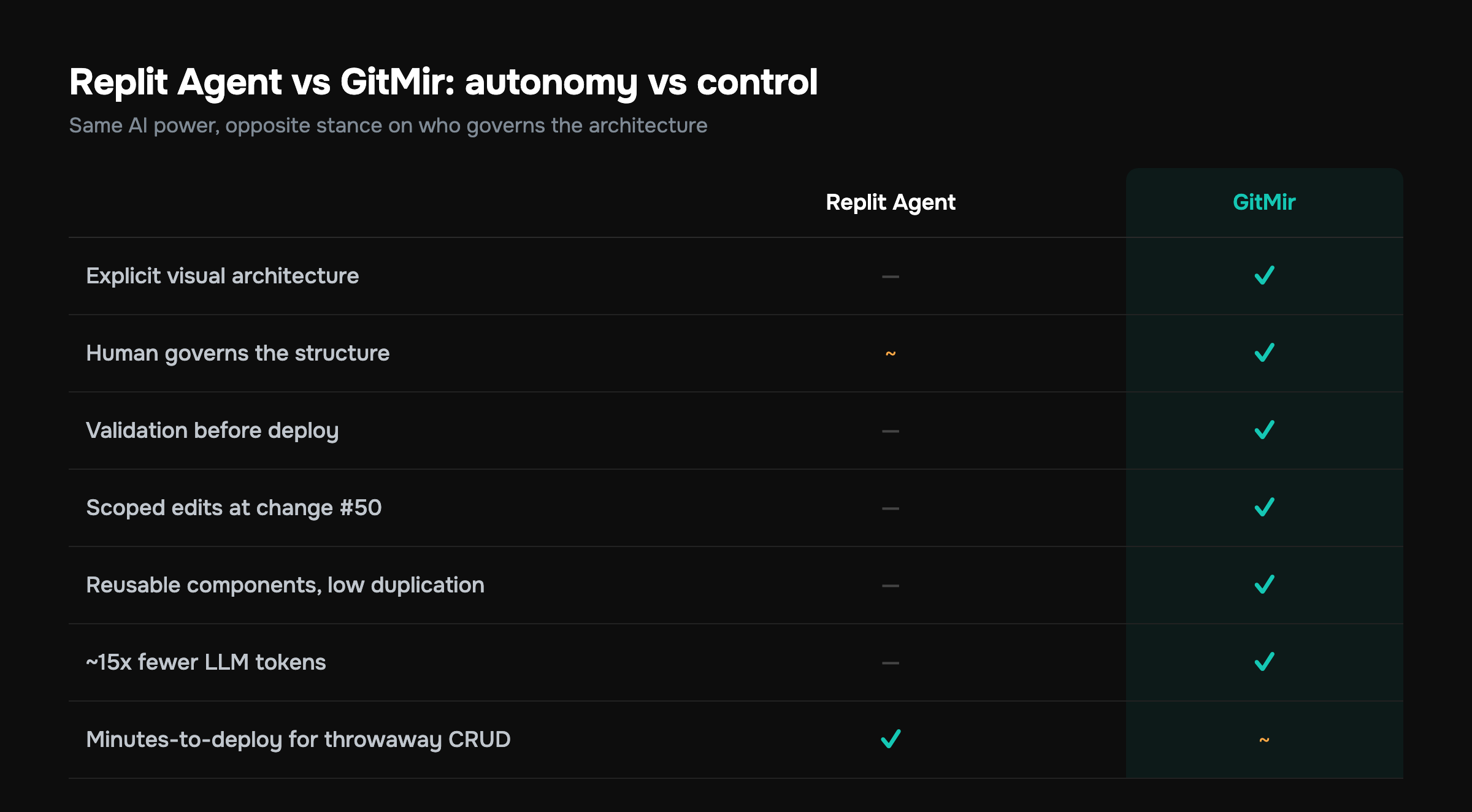
| Dimension | Replit Agent | GitMir |
|---|---|---|
| Core philosophy | Autonomy — agent decides and builds | Control — you author architecture, AI fills it |
| Where structure lives | Implicit, in generated files | Explicit, in a visual model |
| Time to first deploy | Excellent (minutes for CRUD) | Fast, after modeling the architecture |
| Human in the loop | Optional; agent runs the loop | By design; you govern the structure |
| Validation | Runtime / after deploy | Against architecture, before deploy |
| Behavior on change #50 | Drift, regressions, re-explaining the app | Scoped edits inside a known model |
| Duplication tendency | High (clone-and-prompt) | Low (reusable components) |
| Token economics | Pays to re-infer the app each loop | ~15x fewer tokens via scoped generation |
| Best fit | Prototypes, demos, learning, throwaway | Products meant to live and grow |
Read the table as two different jobs, not a scoreboard. Replit Agent is optimized for getting to a running app with zero friction. GitMir is optimized for building something you and a team can keep changing safely. Pick wrong in either direction and you waste time. Heavyweight control on a throwaway demo is overkill; raw autonomy on a system that needs to last is a slow-motion cliff.
A realistic scenario: the SaaS that got traction
Picture a two-person startup. They prompt Replit Agent into a working scheduling SaaS in two days — auth, calendar, payments, deployed. They demo it, land a design partner, and the design partner wants three things: team accounts, a usage-based billing tier, and an audit log.
With pure autonomy, each ask sends the agent back into a codebase it has to re-understand. Team accounts mean reworking the data model the agent chose unilaterally on day one. Usage billing touches code the agent wrote three different ways across three prompts. The audit log requires knowing every place state changes — which nobody documented, because nobody designed it. Velocity doesn't just slow; it inverts. Now run the same asks against an explicit model. Team accounts is a change to a known data-flow object. Usage billing slots into the billing module. The audit log hangs off the business-logic layer that already names every state transition. The work is scoped, reviewable, and validated before it ships.
That inflection — traction turning autonomy from an asset into a liability — is the single most common reason teams come looking for a Replit Agent alternative. It's rarely that the prototype was bad. It's that the prototype's architecture was never a decision, and now it needs to be.
How to actually choose
A few honest heuristics, founder to founder:
- If it's disposable, choose autonomy. Demo, spike, internal one-off, learning project — Replit Agent's frictionless loop is the right tool. Don't over-engineer a thing you'll delete.
- If it has to live, choose control early. The cheapest time to make architecture explicit is before the cliff, not after. Retrofitting structure onto an autonomously-built app is the hard version of this job.
- Watch for the trigger events. A second engineer joining, real customer data, a compliance requirement, or your fourth feature breaking your first — any of these is the signal that you've left throwaway territory.
- Separate "writes code fast" from "stays changeable." Almost every tool now does the first. The second is where projects actually fail, and it's the question worth optimizing for.
Want the broader landscape instead of a head-to-head? Our roundup of the best AI coding tools in 2026 maps where each tool sits on this autonomy-versus-control axis. And if the term "agent" itself is still fuzzy, what an AI coding agent actually is breaks down the loop these tools run.
The cost nobody prices in
There's a number that never shows up on any tool's pricing page: the engineering hours spent fighting code you didn't design. Autonomy front-loads the savings and back-loads that cost. By the time you feel it, it's already accrued.
This is also where the token math compounds. Every time an autonomous agent re-reads your whole app to make a localized change, you pay for the re-inference — and you invite the drift that re-inference causes. GitMir's scoped, architecture-bound generation is what produces the ~15x token reduction, but the dollars are the smaller half of the story. The bigger half: scoped changes don't silently rewrite things you'd already gotten right.
The real comparison isn't time-to-first-deploy. It's total cost of ownership across a hundred changes — tokens, debugging, regressions, and the meetings spent re-explaining your own app to a model.
Want to put numbers on your own situation rather than trust a blog post? That's exactly what we built the ROI calculator for.
The bottom line
Replit Agent and GitMir aren't really competing for the same job. They're betting on opposite sides of the autonomy-control trade. Agent is a superb way to get a running app with no friction, and in 2026 it does the standard scaffold-and-deploy path reliably and fast. If your goal is a prototype, a demo, or a quick exploration, that autonomy is the feature, and you should use it without guilt.
But autonomy and predictability pull against each other, and the moment software has to hold real data, support real users, and survive real change, predictability becomes the thing you can't buy back cheaply. GitMir's answer is to make architecture an explicit, visual decision, let AI generate inside it, validate before deploy, and lean on reusable components — keeping the AI speed while putting you back in control of the shape. That's the whole difference. And it's the difference that decides whether month three is a victory lap or a salvage operation.
See how visual architecture and validated generation work on the product page, run your own numbers with the ROI calculator, or start free when you're ready to build something meant to last.
More on this, with the numbers behind it
What business logic is, and where it lives →Features, rules, customer paths and how they connect — why nothing a team already owns holds them in one place, and what that costs.Every tool in this market, side by side →What each one is built for, and the line between assembling context and holding it.What your AI actually costs →Your engineers, your loaded cost, your monthly AI bill — counted on your own numbers, not ours.GitMir Vibe →Your coding agent gets the rules and customer paths a task touches before it writes code, and each change is checked against them before it is committed.An architecture nobody wrote by hand →Areas, customer paths, rules and status flows of a real product, built from its source and published in full.Put a number on your own workflow
Bring us the recurring workflow where AI still needs expensive people to supervise, review and correct. We baseline what it costs and put the target in writing before we build. Or connect a repository and see it on your own code first — 10,000 credits free, no card.
Build My Business Case → Start free →Frequently asked questions
Is Replit Agent reliable enough for production apps?
For standard scaffold-and-deploy CRUD apps in 2026, Replit Agent is reliable and reaches working deployment in 10–15 minutes. Reliability drops as projects grow complex, where its CEO cites reliability and integration as the main barriers. For production systems with real data and ongoing change, add explicit architecture and validation before deploy.
What's the main difference between Replit Agent and GitMir?
Replit Agent maximizes autonomy — the agent decides the architecture and builds the app from a prompt. GitMir maximizes control — you author visual architecture (modules, data flows, APIs, logic) first, and AI generates structured, editable objects inside it, validated before deploy. Same AI power, opposite stance on who governs the structure.
Why do autonomous AI agents struggle as projects scale?
Because their architecture is implicit — whatever the model produced across many prompts, never deliberately designed. Each change forces the agent to re-infer the whole app, causing drift, regressions, and duplication. Studies of AI-assisted codebases found AI-era code clones rising while refactoring fell, signaling exactly the maintenance-cost growth that produces the scaling cliff.
Is there a good Replit Agent alternative for long-lived products?
Yes — if your app must live and grow, choose a control-first approach over pure autonomy. GitMir is built for this: explicit visual architecture, AI generation scoped inside it, validation before deploy, reusable components, and roughly 15x fewer tokens than ad-hoc prompting. It keeps AI speed while making the architecture a decision you own.
Does GitMir replace coding agents like Replit Agent or Cursor?
No — GitMir reframes where AI generation happens. Tools like Replit Agent and Cursor generate code into an implicit or repo-level structure; GitMir generates structured objects inside an architecture you author and validate. The AI horsepower is similar; the control surface differs. Choose autonomy for throwaway work, control for software meant to last.
How does GitMir reduce LLM token costs versus prompt-based agents?
GitMir scopes generation to discrete objects inside an explicit architecture, so the model never re-reads or re-infers the whole app to make a localized change. That scoping yields roughly 15x fewer LLM tokens than ad-hoc prompting, and it also reduces drift — because the AI isn't silently rewriting code you'd already gotten right.

Related articles
Cursor vs Copilot vs GitMir: Which AI Coding Tool Keeps You in Control?
Cursor and Copilot make you faster at writing code. GitMir makes your whole system visible and controllable. Here's how they compare — and when you need more than autocomplete.

What Is an AI Coding Agent? (And Where It Helps vs Hurts)
An AI coding agent plans and executes multi-step coding tasks on its own. Powerful — but without structure and validation, autonomy amplifies mistakes. Here's how to use agents safely.
Cursor Alternatives: 6 Options for Teams Who Need Control
Cursor is a great AI editor, but it's not the only — or always the right — choice. Here are six alternatives, what each is best at, and when you need more than an editor.